Saturday, June 4, 2011

Musing on Kitties

Because we all know that the internet is powered by adorable and funny cat pictures, it's about time I paid my dues.


No joke, this ^ was voluntary.


^ This was her 'safe place' when we would leave to go anywhere (and this picture won a contest once upon a time!).

Serephina was contemplating sending Brat to Abu Dhabi. ^


And some of our foster kittens...


So, there, internet. Caption away or just enjoy the kitties.

Friday, May 20, 2011

AAP Surprises

There are a few things you may not know are recommended by the American Academy of Pediatrics. Some people get outdated information and others simply misunderstand the language. Here are a couple things that are not considered mainstream (but should be!) that the AAP, who is supposed to be the mainstream 'go-to' (especially for pediatricians) recommends.

Cosleeping
http://82cottage.com/images/Bedroom%202%20double%20+%20crib.jpg
The first thing that comes to most minds when they hear "cosleeping" is baby in the parents' bed. But really, that's just one type of cosleeping, referred to as 'bed sharing' to be specific. Another form is to have baby in a crib or cosleeper attached to the bed and yet another is to have the crib in the parents room. The AAP actually recommends that babies spend the first six months of life in their parents' room, in a separate sleeping area (a bassinet, cosleeper or crib). This benefits both the research that cosleeping is better for babies and crib manufacturers, who hate those studies. "Mother and infant should sleep in proximity to each other to facilitate breastfeeding."

Rear-facing for Two Years (and beyond!)

Her chest clip needs to be adjusted a little bit here, but this is Lilly, rear-facing at 2 1/2.
The AAP advises parents to keep kids rear-facing as long as possible, up to the maximum limit of the car seat. The current (new) minimum recommendation is now 2 years. Most people aren't aware that this is the recommendation, because they have been following the minimum law (if at all), much to the potential detriment of their children. Children under 2 who are rear-facing are 75% less likely to be fatally injured in a car accident.

Feed On Cue, Not Schedule
Feeding the wild
There are repeated comments on this in the official AAP guidelines, from "Crying is a late indicator of hunger," to "During the early weeks of breastfeeding, mothers should be encouraged to have 8 to 12 feedings at the breast every 24 hours, offering the breast whenever the infant shows early signs of hunger such as increased alertness, physical activity, mouthing, or rooting."
A1
Breastfeeding Past the First Year

The AAP's official stance: "There is no upper limit to the duration of breastfeeding and no evidence of psychologic or developmental harm from breastfeeding into the third year of life or longer."

So there you have a few things you may not have know that the AAP recommends.

Saturday, May 14, 2011

Don't Schedule Cesareans for Breech babies!


Breech presentation is not a valid reason to schedule a cesarean. Yet, whenever a care provider finds a baby in the breech position in the last few weeks before the EDD, they ask the parents to pick their baby's birth day.

Now, people consider breech presentation one of the main reasons to have a cesarean. However, while I'll agree that with the prevailing ignorance of the average obstetrician in catching breech babies, in the hospital, it may be safer to have a cesarean--if the baby is presenting breech in labor.
https://blogger.googleusercontent.com/img/b/R29vZ2xl/AVvXsEhxEiw26EOAgXoXtkeuCkbYWez4xoy677u4zwMMfkfPgQJaOaX3i_q1GPjowyZSRzggllisNTBHN8IrP9HbynatTk7V_CnOMlVQ-V69EvYo9xg1uZ8P-zbLcqFi-1b9QVhfeusNtYclDmw/s320/BreechPositions2.jpg
Babies can turn in the womb as late as in active labor, into a vertex, or head down position. So, scheduling a cesarean is foolish, especially if it's scheduled before your EDD. An EDD is not a good measure of when the baby is coming, unless you see it as the middle of the average: 38-42 weeks. So, scheduling a cesarean for 38 weeks is not a good idea unless you have full placenta previa or another reason that labor must be avoided.

Ideally, you should go on with a breech pregnancy with the belief that baby will turn. You can use the techniques at Spinning Babies to help a stubborn baby point in the right direction. If you are approaching the big day and you've tried positions, inversions, chiropractic care, shining a light down low, etc. and baby is still breech, many obstetricians can perform what is called an external cephalic version.

A version should be a last resort, as it is uncomfortable and comes with its own set of risks, including PROM (premature rupture of membranes), premature labor, bleeding and fetal distress leading to the need for an emergency cesarean. The success rate is around 65%.

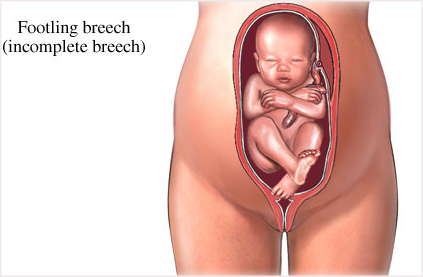
Ideally, you will have a care provider who is trained in breech vaginal birth, which 70% of breech babies are candidates for. This is not a 'new' thing. In fact, it is an old skill that has been virtually lost with the popularity of the cesarean. A transverse baby is a definite risk out--you can't birth a baby shoulder first! Footling breech is considered too dangerous by most care providers to attempt a vaginal breech birth. Baby breathes through the cord and it can become dangerously compressed in a breech birth. The likelihood of this in a footling breech is 15-18%.

Frank breech is the ideal for a vaginal breech, as the baby's legs protect the cord. In full-term, vertex babies, 0.4% suffer from cord prolapse. In frank breech, 0.5% will experience this complication. So, you can see the rate is very similar. The next risk comes with complete breech babies, which have a compression rate of 4-6%, a significant rise, though not as dangerous as footling breech.

Ideally, you should give baby time in labor to finally turn vertex. At the worst, if you end up with a cesarean due to an unsafe breech position that will not resolve or you are uncomfortable with the risk of breech vaginal birth, you will have given your baby all the time he or she needed to 'cook' and even a brief trial of labor can give the baby the benefits of labor, which prepares the baby for life on the 'outside.' At best, your baby will turn in early labor and you will go on to have the birth that you desired and that gives your baby the best start in life.

At the very least, you should research your options and remember that you have the right to make this choice! A cesarean is major abdominal surgery. As common as it is, so are complications--for both you and baby. Scheduled cesareans may be more convenient, but they are not safer than vaginal birth (except when labor would be dangerous in the first place).

Happy Birthing!

Tuesday, May 10, 2011

ADHD Doesn't Need a Cure

Some of this is lacking coherent transitions, please forgive my pregnant brain. I also probably should cut off most of the end, but I wanted to get all my thoughts on this subject out in just one entry.


Something that comes up as often as people looking for a cause for autism is a cause for ADHD. Because if there's a cause, like some kind of infection, it can be rooted out and cured. But I don't believe that. I don't believe it's as simple as people want it to be. If you've read any older literature, you know ADHD has been around longer than televisions, ultrasounds, vaccines and artificial dyes. It's not likely any more prevalent today than it was 200 years ago--we just have a name for it now. A 'diagnosis' and a 'fix' (or twenty). When you look for something, you are much more likely to find it than you are when you don't even know it exists.

There's a story that was told by Sir Ken Robinson at a TED talk in 2006:

“And the third thing about intelligence is that it's distinct. I'm doing a new book at the moment called Epiphany, which is based on a series of interviews with people about how they discovered their talent and actually about how people got to be there. It was really prompted by a conversation I had with a wonderful woman who most people have never heard of; she’s called Gillian Lynne. … She's a choreographer, and everybody knows her work. She did Cats and Phantom of the Opera. …

"Gillian and I had lunch one day, and I said, 'How did you get to be a dancer?' She said it was interesting. When she was at school, she was really hopeless. And the school in the 30’s wrote to her parents and said, 'We think Gillian has a learning disorder.' She couldn’t concentrate; she was fidgeting. I think now they'd say she had ADHD. Wouldn’t you? But this was the 1930s, and ADHD hadn't been invented at this point. It wasn't an available condition. People weren't aware they could have that.

"Anyway, she went to see this specialist … She sat on her hands for twenty minutes while this man talked to her mother about all the problems Gillian was having at school. … In the end, the doctor went and sat next to Gillian and said, 'Gillian, I've listened to all these things that your mother's told me. I need now to speak to her privately. Wait here; we'll be back. We won't be very long.' And they went and left her.

"As they went out of the room, he turned on the radio sitting on his desk. When they got out of the room, he said to her mother, 'Just stand and watch her.' The minute they left the room, she said she was on her feet, moving to the music. They watched for a few minutes, and he turned to her mother and said, 'You know, Mrs. Lynne, Gillian isn't sick. She's a dancer. Take her to a dance school.'

"I said 'What happened?' and she said, 'She did. I can't tell you how wonderful it was. We walked into this room, and it was full of people like me: people who couldn’t sit still, people who had to move to think.' … She was eventually auditioned for the Royal Ballet School; she became a soloist; she had a wonderful career at the Royal Ballet. She eventually graduated from the Royal Ballet School and found her own company, the Gillian Lynne Dance Company and met Andrew Lloyd Webber. She's been responsible for some of the most successful musical theater productions in history; she's given pleasure to millions, and she's a multimillionaire. Somebody else might have put her on medication and told her to calm down."*


This principal is trying to work to change people's views on ADHD, which I think really needs to be the goal. The perspective on ADHD needs changing, not the children. It's very defeating to hear that you are a 'problem' that needs to be 'fixed.' Especially when that problem is the way your mind works.

I, too, can think most effectively when I'm in motion--or when I have everything else in the world shut out through music. I put on headphones, point myself at a computer and words pour out by the thousands--no exaggeration. I wrote an entire book in a matter of weeks doing this. I'm only just now learning how to work with the way I think, because I wasn't given the chance to adapt and adjust and know my own mind, from a short time after I was diagnosed with ADHD.

We all know ADHD is highly over-diagnosed. But I think there is a secondary problem, too: a 'mimic' condition that presents as ADHD, but does have a cause. Like heavy metal toxicity emulating autism and being curable, some children diagnosed with ADHD can be 'cured' by adjusting their diet. This isn't a new idea, I first heard about it in the 90s. But I've also seen this strategy fail and it's not a cure-all for ADHD. Because there isn't one.

Because it doesn't need to be 'cured.'

Now, I don't have grandiose ideas about how to help educators deal with the unique needs of children with ADHD. Frankly, I'm not a fan of public schools (largely due to my run in them) or any form of institutionalized schooling, for that matter. Particularly not for anyone with an unconventional mind. I'm not an unschooler, I believe in structured schooling. I think. Ask me when my four year old is closer to eight and maybe I'll have a more firm idea on that. I'm still new at this.

I know that children who must go to school must get along in school. But I strongly disagree that forcing them into patterns of instruction that they do not learn from and giving them drugs for the benefit of others and not the child receiving the drug is the answer. It's not. Concessions need to be made. I don't have the answers as to what--but I believe that's where ADHD research should be focused. Not on drugging away the special way that ADHD kids think, but in teaching educators how to use it, instead.

I think this is easiest for homeschooling families, as they have a wide berth to individualize their teaching and typically don't have 20+ students in one room, trying to learn the same thing. I know I've read at least one homeschooler's blog where she had adjusted for her two sons who have ADHD--they could do their work, right on track with peers, but needed to be able to move around while they did. I wish I could find that blog to link to it, she had such a wonderful outlook and great ideas on alternative education ideas.

Some parents refuse to get the child tested, for fear of a 'label.' I don't think that's helpful for everyone... I know how much labels hurt, but I also know that they help you to understand what's going on to adjust for it. Children without labels are equally stigmatized in school--they just don't get any compassion, either, because they're still going to be labeled: troublemakers. The problem is that some teachers automatically apply that label when they hear "ADHD" but many will have more empathy with the diagnostic label than just their own.

We can't stop teachers from being human. We shouldn't be trying to stop our children from it, either. I don't see ADHD as a psychiatric disorder--I see it as a personality trait. Yes, it's caused by chemical reactions in the brain being different from the average person. So what? We all have different chemical reactions in our brain. Some of us just have more obvious differences than others.

ADHD kids just think differently... and society needs to start thinking differently about ADHD.


*Here, you can watch the entire twenty minute talk, “Do schools kill creativity?” that this story was taken from (about 15 minutes in)

Thursday, April 7, 2011

Only One Absolute in Pregnancy

There's only one absolute in pregnancy and that is that the baby is going to come out eventually.
gift from above
image courtesy of stockxchng

So, when we think about getting pregnant, we think of certain things immediately. Missed periods. Nausea. Strange cravings. Big bellies. Did you know that none of these are absolutes?

The missed period

Okay, so this really is an absolute in a way--no one has a 'period' while they are pregnant, in that they aren't shedding the uterine wall lining in preparation to begin the ovulation cycle again. However, many women experience vaginal bleeding that can mimic a period for a month or even the entire duration of pregnancy. So, some women don't know they're pregnant right away, because they think that their cycle is continuing. This is especially problematic for women who have never had a stable cycle.

"Morning Sickness"

It seems like most people know by now that morning sickness has nothing to do with the time of day for many women. The reason that some women only experience it first thing in the morning (and why 'remedies' include eating something carbohydrate-bearing before you get out of bed) is that it's often tied to blood sugar.

Many women never experience morning sickness.

So, this is, again, not an absolute sign of pregnancy or lack thereof. While some women are tortured with morning sickness their entire pregnancy, for most women, it vanishes somewhere between weeks 10-14, after the placenta starts picking up in week 10. Sometimes morning sickness just translates as a reduced or increased appetite (depending on the mom-t0-be).

Personally, I didn't have it until my second trimester with my first, had it horribly with my lost baby, none with my second daughter and this pregnancy has been a low level nausea for about 80% of my day on average.

Strange Cravings

If you say you want pickles and ice cream, someone will likely joke that you must be pregnant. However, aversions are possibly more common than cravings! Again, this is a symptom that some women just don't get (or don't notice if they do, especially if they're used to having weird taste). And not all cravings are of foods you wouldn't normally want--common food cravings include fruit or meat and have all sorts of old wives' tales surrounding them (usually about gender).

For the record, my pregnancy cravings have gone as follows: fruit like crazy with my first girl and meat and veggies with my second girl. This pregnancy has been all about the meat, potatoes and cereal. I could really go for Steak Monterrey right now with a baked potato and Frosted Flakes for dessert. But I could probably fill a journal with things that gross me out.

Big Bellies

This one is rather hard to escape. When people talk about women 'not showing' through their whole pregnancy or being able to hide it, they immediately assume that the woman must have been fat. Which is totally untrue. I have a friend who is very thin and it took her almost to 30 weeks before she 'popped' enough for it to be visible past her shirt. We all could see her adorable bump before, of course, because we knew what we were looking at--but to a stranger, she didn't really look very pregnant.

Of course, having some extra pounds on can obscure a developing baby bump. I once had two horrible women debate whether I was pregnant or just fat right in front of me at the grocery store when I was 8 months pregnant and feeling beautifully pregnant. After that, I got a "Baby" patch and safety pinned it to whatever shirt I was wearing. I can't tell you how much that still hurts my feelings.

However, some women, for some reason, just redistribute the weight in a way that they think they're putting on a little weight and it doesn't show in that distinctive basketball shape. A heavier woman is more likely to have this happen, but it certainly doesn't only happen to women with curves.

A Positive Pregnancy Test

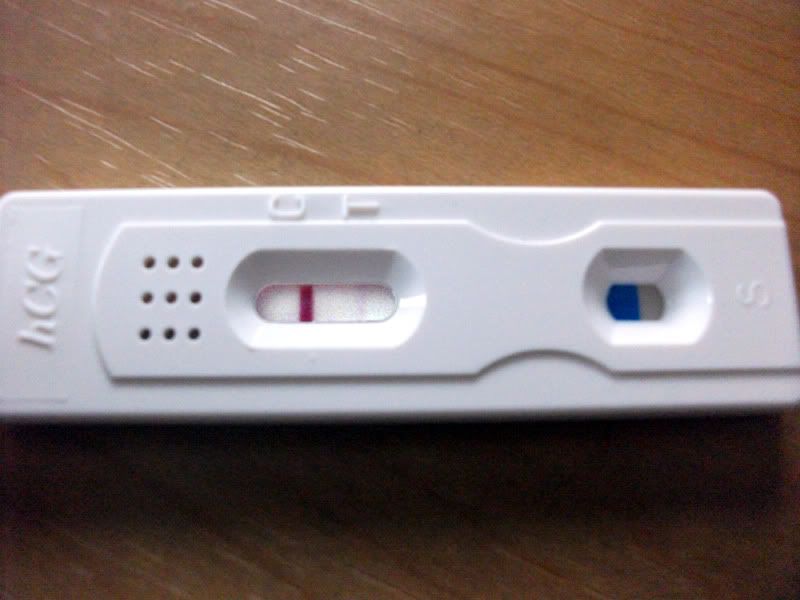
False positives on pregnancy tests are very rare and happen mostly with +/- tests. Surprisingly, Dollar Store tests are often more reliable and can tell you pretty early if you're pregnant. However, false negatives happen far more often. That's right, you can get a negative pregnancy test and still be pregnant. Usually, it comes from testing too soon (because you ovulated later than you realized or you were just too excited to wait), but for some women, rarely, they just never get a positive pregnancy test.

I have a friend who never had a positive pregnancy test in her entire pregnancy. If you look it up, it happens enough that it's a 'thing', but there don't seem to be any statistics on this phenomenon. It's not a sign that you're going to miscarry, either. For some reason, some women just don't seem to pass hCG into their urine.


Now, reading all that, it might sound like there's just no way to prove you're not pregnant, but really, to have all of these happen at the same time is so unlikely as to be virtually impossible. A blood test can usually confirm pregnancy where urine tests can't and the vast majority of women will stop bleeding, get tired, moody, sore and nauseous. Still, other than the baby eventually coming out (which can take up to 45 weeks, by the way--though 42 is much more normal in a first time mom and 41 or less in moms who've had more than one), nothing is certain in pregnancy.

And yes, there was one woman, once, who, for some reason, carried a fetus for 46 years. However, she still went into labor--she was just frightened out of the hospital and her ectopic baby never came out--probably because it was never in the uterus to be expelled. Had she stayed, her baby would have been taken by cesarean. No one can know if the baby was even alive at that point, but it was a very strange occurrence. And the baby did come out, after her body finally decided it was tired of the charade and she got sick. Since this is the entry for oddities, it would be incomplete without mentioning her.

Oh, and just for the mention...

Nine Months

Pregnancy is considered to begin before you're actually pregnant, for the formula that people use to calculate the due date. I originally wrote "modern" due date, but it's not. It's actually several hundred years old and created by a botanist. However, it's because the menstrual cycle is much easier to track than ovulation. Ovulation can vary by a week easily, so unless you're charting your fertility, you might not be ovulating when you think you are.

So, you are pregnant for two weeks before you get pregnant. Women who chart their cycles would do better, when reporting their LMP (last menstrual period) to simply go back two weeks from their ovulation date and list that date as their LMP. So, the EDD is 38 weeks from ovulation/conception, basically.

Still, "nine months" is 36 weeks, since pregnancy is charted by lunar months, not calendar. Since we are supposed to be pregnant for 40 weeks (give or take 2-4 weeks), that is actually ten months. "Nine months" really comes from the calendar, more than an accurate measure of months. The number of months pregnant you are is divided by four weeks--not what month it is, so it's more accurate to say that pregnancy lasts ten months, but you're typically only aware of it for nine of those months anyway.

So there you have it. There's only one absolute in pregnancy and that is that the baby will come out. Unless you're that one lady in Morocco.

Tuesday, March 29, 2011

I'm Different


Every time I read about a postpartum guideline, I think how very sad I would be to be treated that way. The most recent was about limiting the visit to 15 minutes like a time nazi. I would feel so dismissed and like I wasn't worth my visitor's time--like I was putting them out--if someone did that to me. Yes, there are times where I want short visits, but if I actually invite someone over for a visit (very rare in the first place), 15 minutes isn't going to cut it.

I am a social person. I hate how isolated I felt after the birth of my second. I didn't want to be alone with her (especially switching from one baby to two!). I have no problem nursing around people (so if you're around me, you have no problem with it either, or we won't be seeing each other much). I loved having my MIL come out to see the kids after they were born--and we didn't use to get along at all. And one of the highlights after Naomi was born was the baby shower a few days later.

If you're just dropping something off, someone will meet you at the door or your car, lol. But don't be scared to invite me out just because I just had a baby. I'll say no if I'm not up to it. But don't just squee and run. I like to share my babymoon. Maybe I'll feel different after I finally get a natural birth. Only time will tell.

Mostly, this was so I'd quit wanting to post frowny faces on all those guides!

Are those guides accurate for you? Did you want people to just leave you and your baby alone during your babymoon?

Thursday, March 24, 2011

Hi, everybody

Sorry about dropping off the face of the earth, but I've been a bit busy... creating life.

I'm 7 weeks, 5 days pregnant. Remarkably, I got pregnant on the first try. We didn't think that would ever happen. My first little girl took 18 months of trying before I gave up--right after getting pregnant ;) My second was 8 months with two losses in the meantime and required supplements. So, I'm going to be a nervous Nellie for who-knows-how-long while I go from pregnancy milestone to milestone.

I'm having a yucky first trimester, but since a friend has hypermesis gravardium (where you puke endlessly, end up having to go to the hospital to be hydrated, etc.), I don't really see it as that bad. I take morning sickness vitamins and have only puked once, even if I spend about 80% of my waking time feeling like I'm going to and being afraid of it, because I'm exhausted, weak and can barely tolerate much food.

On the night I ovulated, I had a dream. This dream was so interesting that I overslept and had to tell a friend all about it. I wrote it down as a micro-fiction and that friend told me I should make it into a book. I laughed, because that seemed so silly, but the worm was in my head and I decided to write a short story.

Exactly 3 weeks later, I had over 100,000 words--a full novel. I wrote an average of 5,000 words a day (my daily goal) and put in 8-14 hour days on it. I was driven and I enjoyed it. I felt so fulfilled and productive. I've never written like that in my whole life. All the while, this little bean in there grew, implanted and started the road to becoming a baby. My little muse. My muse has always taken maternity leave when I get pregnant, so having him go into overdrive was strange and welcome.

So I've neglected my blog, dramatically and I'm sorry. But I'm also not sorry, as I had quite legitimate reasons. I don't know how active I'll become, since not a lot has really come up, parenting-wise, lately, that isn't already super-blogged. I'll eventually cover car seats and the new recommendation, but that's for another day. Today, I want to go lie on the couch and veg out, trying to forget about the ever-present nausea and overwhelming cravings for potatoes.

Sunday, February 27, 2011

What Christians Should Know Before They Circumcise

Family Matters
Many people claim "religion" as a basis for circumcision, but there are a few errors with this. For one, many Jews have abandoned the practice as archaic (just like women being secluded as 'unclean' on their periods). Another is that though it is a Muslim tradition, it is not only not in the Qur'an, but it violates the exact phrase "We have indeed created man in the 'best of moulds'." (Qur'an 95:4) and "The One Who has 'perfected everything' He has created and began the creation of human beings from clay" (Qur'an 32:7)

Still, those two groups aside, it is Christians where the puzzlement ultimately lies, as it circumcision is expressly spoken against in the New Testament and the Bible couldn't be more clear:

"Behold, I, Paul, tell you that if you be circumcised, Christ will be of no advantage to you." – Gal 5:2

"And even those who advocate circumcision don’t really keep the whole law. They only want you to be circumcised so they can brag about it and claim you as their disciples." – Gal 6:13

"For there are many who rebel against right teaching; they engage in useless talk and deceive people. This is especially true of those who insist on circumcision for salvation. They must be silenced. By their wrong teaching, they have already turned whole families away from the truth. Such teachers only want your money" – Titus 1:10-11

"Watch out for those wicked men – dangerous dogs, I call them – who say you must be circumcised. Beware of the evil doers. Beware of the mutilation. For it isn’t the cutting of our bodies that makes us children of God; it is worshiping him with our spirits." – Phil 3:2-3

"And I testify again to every male who receives circumcision, that he is in debt to keep the whole Law. You who do so have been severed from Christ...you have fallen from grace." - Gal 5:3

"As God has called each man, in this manner let him walk. And thus I command in all the churches. Was any man called in the circumcision [Old Covenant]? Let him not try to become uncircumcised. Has anyone been called in the uncircumcision [New Covenant in Christ]? Let him not be circumcised! Circumcision is nothing. And uncircumcision is nothing but the keeping of the commandments of God. Let each man remain in that condition in which he was called." - 1 Cor. 7:17

"And some men came and were teaching the brethren, 'Unless you are circumcised according to the custom of Moses, you cannot be saved.' But Paul and Barnabas together had great dissension and disputing with these men. . . Then Peter stood up and said to them 'Why do you put God to the test by placing upon the neck of the disciples a yoke which neither our fathers nor we have been able to bear?" - Acts 15:1-2, 7, 10

"But if I still proclaim circumcision. . . then the stumbling block of the cross has been abolished." - Gal 5:11

"I wish that those who are pushing you to do so would mutilate themselves!" - Gal 5:12


Just food for thought. According to the New Testament, you are not a Christian if you are circumcised unless you become 'uncircumcised'. It's not cleaner. It doesn't prevent HIV. It does cut down on UTIs... for 12 months in a population that suffers few to no UTIs (little girls get FAR more). No baby is born with a full grown man penis, so he'll never look like his father (especially since he has mom's dad's genes in there, too) and men don't actually compare penises that much anyway. A little boy is going to care more about the hair than if the tip is pointy or round. It's not even the majority--80% of the world is intact. And finally, just because he doesn't consciously remember it, doesn't mean he doesn't remember at all.

Finally, I know this is a sensitive topic. I am not criticizing anyone's choices, I am simply providing a short bit of information that, on top of my belief that everyone should have a say in their own body regarding cosmetic surgery as well as the fact that the adult penis is easier and safer to alter (and the men get better drugs to kill the pain after, while infants in the first 7 days have less natural pain relief). I have no issue with circumcisions, mine is an issue of consent. I don't agree with infant ear piercing, either.

Thursday, February 24, 2011

Women's Fertility

Most women know the basics of their cycle. It's typically 28-30 days, you ovulate in about the middle of that and if you're pregnant, menses stops. But that's a very, very basic understanding. Did you know that your cycle actually has four parts? Did you know that your body temperature changes to reflect that? And did you know that that fluid that seems to change so much is also a reflection of that? Did you know that your cervix changes? Even your saliva changes!

First, we have menses. That's your period. It lasts 2-5 days in the average woman and your cycle starts on the first day that you bleed--not the first day that you spot. That's Cycle Day 1 or CD1.

On CD 1, your temperature will be a little above its lowest and cervical fluid (also known as cervical mucus or CM, but fluid sounds better, doesn't it?) will be obviously hard to determine. Your cervix will be hard, like the tip of a nose, high up in your body and closed.

The next phase of your cycle is called the follicular phase. That's when your follicles are maturing and growing eggs to be released in the next phase. You grow 5-7 eggs and release FSH (Follicle Stimulating Hormone) that causes the follicles to mature your eggs. They start producing estrogen that, when it peaks, stimulates the release of LH (Luteinizing Hormone) that is detectable by ovulation predictor kits (OPKs). The reason that they require a dark line to be positive is because when the LH peaks, that's when you release your egg(s). The LH surge (the highest concentration of LH) occurs 12-24 hours prior to ovulation but LH begins to rise about 36 hours before ovulation. Your temperature may go up and down a little, but it will stay in the same vicinity during these two weeks (approx).

Next is ovulation. In a woman with a textbook cycle, this happens on CD 14. This happens when the biggest, most mature egg is released at the peak of your FSH release. Sometimes two or even three mature enough to release. This is what causes fraternal multiples. The rest of the follicles and developing eggs die around CD7 or so.

Just before and during ovulation, your fluid will become watery or like the consistency of egg whites. That's fertile fluid and yes, the most fertile is called EWCM (egg white cervical mucus). It gives sperm the ideal environment to reach the egg (and facilitates sex). Your cervix moves down and opens, becoming soft, like lips. Your temperature may plummet or it may not move at all.

Sperm can live up to five days in a woman's body, so if you have unprotected sex as close as that, you have a chance at having a baby--and probably a girl. It's not very likely, though--sperm rarely lives more than three days and it depends on how 'hospitable' your body is to it.

The final phase is called the luteal phase. The corpus luteum is the dominant follicle, that is transformed by LH and starts producing progesterone. The day after you ovulate, your temperature jumps. In the space of three days, it can rise as much as a whole degree.

Now, all of this temperature stuff can only be monitored first thing in the morning. Basically, you set an alarm that lets you have had at least 3 hours of uninterrupted sleep (mine's set for 9:30am, but I woke up every day for the last two weeks at 8-something and temped--it's important to temp when you first wake up, before you do anything else, to be the most accurate) and take your temp. Write it down or memorize it (or use a thermometer that remembers) and go back to sleep or get up for the day.

The luteal phase ideally lasts 14 days (the 'two week wait' is what it's referred to by women waiting to see if they are pregnant for any reason). Few things are ideal, however, and it can last 12-16 days and be perfectly healthy. 10 days is considered the minimum length of a LP to last and still be able to become pregnant. Now, it ends on the day your period starts, so that's why it's important to last long enough for a baby to implant. I had a 7 day LP and still managed to get pregnant, but I lost the baby. A LP that short is defective. My first baby was conceived with a 10 day LP (approx, as I wasn't temping).

The luteal phase is largely the reason for variations in cycle. If you ovulate on CD 16, you might have a 30 day cycle. If you ovulate on CD 12, you might have a 26 day cycle, so on and so forth.

The cervix closes and rises back up into the body at this point. It becomes firm again and fluid can vary from this point and doesn't matter much. You can start producing 'fertile' looking fluid as your menses approaches or when you become pregnant.

If you are not pregnant, the corpus luteum dies, your temperature drops and within a day or so, you begin menses.

If you are pregnant, your temperature stays up (but can fall after a couple weeks, so it's important to stop temping so you don't become frightened if it drops--it becomes useless after you're already confirmed pregnant).

You can read more about the phases of your cycle here if you like or in the book Taking Charge Of Your Fertility, which is the highest rated book for learning about how your fertility works. I prefer Fertility Friend myself, as it's basically the Cliff's Notes version, but I haven't read TCOYF to say for sure. You can sign up for an account to track your cycle at Fertility Friend, too!

If you want to chart your temperatures, it's important to use a BBT thermometer (I do not recommend Walgreens Brand--while I have successfully used it to chart for the last two months, it is horribly inaccurate in that it seems to have preset temperatures that it is unable to vary from.. my old one from Wal-Mart was slow and the kids lost it, but it worked much better... most drug stores carry them) as it measures to the hundredth of a degree and not just a tenth. Speaking from experience, yes, this matters.

An interesting thing about pregnancy tests and ovulation predictor kits (or ovulation tests) is that the hormones they detect are similar. You can use an OPK to detect pregnancy! The POAS lady describes it this way: Think of them as identical twins, where hCG (human chorionic gonadotrophin--or pregnancy hormone) is wearing a hat. Now, an OPK can only look at the face of the twins, while the HPT (home pregnancy test) looks for a hat.

So, an HPT cannot see LH (what the OPK looks for) and can only see hCG, while the OPK detects both. Since hCG is only present in detectable levels during pregnancy, a line is a line on the test, no matter how faint, as long as it shows up in the test time. Anything after 10 minutes is an evaporation line (which can still show the pregnancy line, but if it wasn't there a minute before, it's not a positive test). With LH, it's a surge that triggers ovulation, so only a nice, dark, clear line counts.

This is one of my own charts (when I got pregnant with Naomi) to show you how temperature charting works (note the dip at CD7--that's an implantation dip; unconnected dots were artificially high temperatures from illness; the - test lines were confirming that my early loss pregnancy had passed):


So, I hope that you now have a better understanding of how your cycle (and your body) works!

Friday, February 4, 2011

The Hidden Growth Spurt


"My ten month old has been waking frequently at night. I'm exhausted. Help! What can I do? Is this normal?"

Basically every DDC or DDG (due date club/group) gets this question. The responses are usually flooded with confused mothers agreeing that they are going through the same thing. It also seems to be forgotten, as it's not only first time moms who ask this. Probably due to that sleep deprivation. Since pediatricians only talk about physical growth spurts, this one is almost never mentioned to moms to warn them that it's going to happen, and that really sucks.

Because it's going to happen.

I've seen it mentioned only maybe once in an 'about your baby' type of publication. The ten month developmental growth spurt. At this time in baby's life she has just started walking or talking or is making the first attempts to do so. She's typically teething and noticing the world around her even more, as well. Some babies develop separation anxiety at this age that can also contribute.

Now "ten month" is the average age, however, it can happen as early as eight months or as late as fourteen to sixteen months, depending on the child. It lasts anywhere from a week to a few months--again, depending on the child.

It's normal and it does pass. Parents who used some sort of sleep training method almost universally notice it is a complete failure during this time period. It remains ineffective for weeks to months, except in some babies, who may already have medical or psychological issues.

Parents who cosleep report getting crawled on, kicked a lot, rolled over on and just a general increase in sleep activity. Often, a wide-awake baby greets them with the desire to play and or nurse at four in the morning.

Parents who do not cosleep report babies who start escaping their crib, get limbs entrapped in their sleep, cry more often, need to nurse more frequently or simply sit up and start playing at random intervals at night.

Temperament tends to dictate baby's response to this time period--fussy babies fuss, laid back babies entertain themselves, clingy babies cling, etc. All in all, it leads to the same result: tired parents!

Responsive parents seem to have the best luck with babies with shorter times in this phase, but certainly not always. Some previously laid back babies become high needs.

"...even though babies achieve this sleep maturity some time during the last half of the first year, many still wake up. The reason? Painful stimuli, such as colds and teething pain, become more frequent. Major developmental milestones, such as sitting, crawling, and walking, drive babies to "practice" their new developmental skills in their sleep. Then between one and two years of age, when baby begins to sleep through the above-mentioned wake-up stimuli, other causes of night waking occur, such as separation anxiety and nightmares. " 1

amirali

This post is really meant to just give a head's up and an explanation as to why it happens. The 'how to get him back to sleep?!' is, unfortunately, so variable as to not be able to be answered in general (like most baby questions). Different babies have different needs to get through this time period.

Feed the baby (hunger at night continues well into the second and even third year for most children), make sure they're safe and comfortable and try to sleep through the crazies as much as you can. Some babies will let you sleep while they play until they're ready to sleep again (my first was like that--her growth spurt lasted about a month or a month and a half) and some will be super demanding (my second, whose phase lasted about two weeks and I was about to start crying with her by the end of it) and everything in between. The only constant is that "training" is totally ineffective during this time (not that it ever achieves the desired goal of a content, sleeping baby, regardless of appearances) and is basically just torture to everyone involved.

Try to prepare with your significant other for this time period if you can and try not to plan to start any taxing activities that could be really messed up by lack of sleep if at all possible. And just remember--like any other growth spurt, it will pass!