Interesting finds, thoughts, rants and ramblings of a mom who doesn't quite fit in anywhere except with their muse and their family.
Showing posts with label pregnancy. Show all posts
Wednesday, June 24, 2015
Saturday, April 5, 2014
Short Story: The Midwife
This is just a short story I wrote a while back and found recently. Hypothetical future. Enjoy.

The
Midwife
“Oh, Zoe, I'm so
happy for you!” Kristen exclaimed. She sat forward and took Zoe's
hands, sharing an excited smile. Her smile faded as she braced
herself for the answer to her next question, as she always did. “So,
have you contacted your OB?”
Zoe's eyes shifted
to the side. She leaned over and turned her phone off. Kristen's
spirits rose immediately. This was what she was always afraid to hope
for.
“I'm not filing
an Intent to Birth,” she whispered. Really, there wasn't any need,
but people feared what could happen if they were caught talking about
a natural birth. It wasn't allowed.
“You understand
the risks, of course,” Kristen said, lifting her cup of tea and
drinking. Zoe nodded, taking a drink of her own tea.
“I don't want to
move to Norway,” Zoe said. “I don't like the cold. And my whole
family has lived here since before the American Revolution. I
shouldn't have to move just to have a baby,”
“I agree,
obviously,” Kristen said. “I thought you might feel that way when
you told me you'd applied to have your birth control system removed.”
“I had heard
that... that you know of a midwife,” Zoe said softly.
“Oh, yes,”
Kristen said. “I do.”
Zoe looked at the
piece of paper with the address on it and double checked it against
the number on the house in front of her. Part of her was so afraid
that she wanted to run. Then she imagined the alternative, and she
found the courage to knock.
“Now, I can't get
in trouble, right?” Zoe asked. The midwife smiled. This was usually
the first question asked of her.
“If you do not
enter into an Obstetrical Contract, you won't fall under penalty of
law if you deliver out of hospital. All of the risk is on me. If you
tell anyone about what I do—”
“Oh, I would
never do that!” Zoe said, taking her hand. The midwife patted Zoe's
hand comfortingly.
“I know, dear,
and we'll go over all the possible scenarios where you might need to
transfer care later, along with stories to avoid culpability. But if
anyone were to discover me, I would be arrested on charges of felony
medical infringement and face a sentence of five to thirty years.”
“That's
ridiculous!” Zoe snapped, her face flushing with anger.
“I know,” the
midwife said with a sigh. “When my grandmother had my mother, women
still had a choice in where and how they gave birth in most states.
When my mother had me, women still had the choice of how. It's only
been twenty years since the Mandatory Cesarean Act passed, and the
population is already down ten percent.”
“Ten percent?”
Zoe whispered.
“Well, Population
Control would really like to see it drop another ten percent,
but with it still illegal to perform any invasive procedure without
written consent, they're reduced to fining people for having more
than two children per couple. And then, of course, there are loophole
kids.”
“Yeah, my husband
and I aren't comfortable with that,” Zoe said. “We've talked
about it, but we're really okay with two children. While it's unusual
for a man to challenge for custody, it's been on the rise lately with
black market adoption rates going up.”
“There's a bill
in the House trying to eliminate that practice,” the midwife told
her, “Although it's unknown if it will pass.”
“How?” Zoe
asked.
“It provides that
a man who sues for custody cannot put his child up for adoption. If
he's found to have done so, he faces a twenty-thousand dollar fine or
even more. The problem is that Pop Control is fighting it because the
way things are now lowers the number of loophole babies for the exact
reason you stated.”
“Wow. Well, if it
passes, maybe we'll reconsider.”
“Even if it
doesn't, there's a loophole to that problem anyway. Right now,
a man can sue for custody of his child and automatically win if two
or more children are already present in the home. However, if
you have your loophole child before you have biological children or
between your one allotment and your husband's allotment, he won't
win.”
“I never even
thought of that!” Zoe exclaimed, laughing. “That's brilliant!”
“I should warn
you that if you need to transfer with your second child, you will be
required to choose a permanent birth control device,” the midwife
added.
“Is there no way
around that?” Zoe asked.
“Some
obstetricians are willing to do a five year survival clause in their
OC, to provide that you aren't required permanent sterilization until
your youngest child reaches their fifth year alive, at which time,
you have a year to sterilize,” the midwife offered.
“That's sick!”
Zoe protested. “It's like some kind of morbid warranty.”
The midwife nodded
sympathetically.
“If you choose a
vasectomy, you have two options still. If you're willing to pay the
third child fine, you can try to conceive immediately, as soon as
your husband feels up to it. After all, it takes vasectomies a while
to take. That also leaves you open for a loophole baby. Of course, if
you transfer during a loophole birth, many OBs make you sign a
hysterectomy release for your c-section,” the midwife warned.
“This just all
feels so wrong,” Zoe said. “Why is Norway the only place in the
world, except for tribal areas, to not make birth into a legal
situation?”
“According to my
grandmother, it started out small. A few states criminalized
midwifery when it was on the brink of becoming socially acceptable.
OBs fought hard—buying studies, skewing outcomes—to prove that
midwives were dangerous to mothers and babies. The cesarean rate was
rising every year and then the ACOG gave the green light to start
Obstetrical Contracts, which women were required to sign to use the
practice.
“Originally, it
was to guarantee exclusivity. The woman couldn't transfer care, but
she knew exactly the care she would be getting. It didn't seem like a
big deal, since that matched OBs with mothers who wanted their kind
of care. Then the standard of care started shifting. There were no
OBs that offered births without contracts, and then some hospitals
stopped having rooms for labor, advertising as 'c-section only.'
“Next came the
bill that legally defined childbirth as a medical procedure. That was
the beginning of the end. They used it by the same logic that got
midwives out of legal practice. Then came full practices offering
nothing but cesarean delivery. Then, the mandatory cesarean act was
passed. At this point, midwives were totally illegal and just coming
out to protest drew the attention of the law. So we faded into the
night. Women didn't want to risk being caught and trapped into an OC
or lead the law back to their midwives, so they were afraid to make a
lot of noise, too.”
“That's awful,”
Zoe said, shaking her head in outrage. “Why did Norway stay
separate?”
“They always
have,” the midwife answered. “So, do you wish to hire me?”
“What's your
fee?” Zoe asked.
“It's five
thousand for prenatals and birth.”
“That's it?”
Zoe asked, shocked. “It's fifty thousand to birth in a hospital!”
“Surgery is
expensive,” the midwife said with a shrug. Zoe sighed.
“Do you accept
payments?”
“Of course!”
the midwife said cheerfully. “And if five thousand is a real
hardship, we can work out barter if we need to.”
“Oh, no, I can
afford it,” Zoe said with a smile. “As long as it's not all at
once. How much if I have to transfer?”
“It depends on
how far you get,” the midwife said. “Usually, we detect the need
for transfers at five months, so that would be two thousand.”
“I can't believe
how cheap it is!” Zoe said.
“We aren't out to
make profit,” the midwife said. “Almost all midwives have some
kind of side business to live on. Now, what month are you due?”
“According to the
online calculator: October first.”
“Good, I don't
have any clients in late September or any time in October right now,
so I have no problem taking you.”
“I'm glad,” Zoe
said, visibly relaxing.
“Remember that
you cannot announce your pregnancy in any public forums, social
media, et cetera. If you get followed to me, I'll be out of business,
and you'll end up with an OB.”
“Got it,” Zoe
said. “Can I know your name?”
“No, I'm sorry,”
the midwife said. “But you may call me Ann. And of course, all
payments must be in cash.”
“Of course,”
Zoe agreed. “How many babies have you delivered?”
“I've caught
around three hundred babies,” the midwife answered. “I've been
doing this for twenty-five years. I started apprenticing when I was
sixteen. I was amazed when I saw my first vaginal birth.”
“How do OBs stop
women from having accidental vaginal births?” Zoe asked.
“All mothers are
sectioned at thirty-seven weeks, unless they show signs of labor
before that. That's why NICUs have to be so advanced. Many babies who
are supposed to be thirty-seven weeks along are actually thirty-five
and even thirty-seven weekers aren't always ready. Plus, just the
cesarean itself raises the risk to the baby's lungs and digestive
system.”
“Wait, you mean
pregnancy isn't thirty-seven weeks?” Zoe asked.
“Yes. Oh, you
didn't account for that?” the midwife asked. “I should have
asked. Silly of me. You'll actually be due October twenty-second,
then.”
“Wow, that's
almost a whole month!”
“It could be even
two or three more weeks after that,” the midwife warned.
“Really?” Zoe
exclaimed.
“You'll be most
likely to go in almost November. Changing your mind?” The midwife
gave Zoe a teasing smile.
“No! No, I'm...
just surprised is all. I didn't know pregnancy was... forty weeks
long!” Zoe shook her head in surprise. “Even forty-two or
forty-three? I've never heard of that!”
“Oh, I've seen
two pregnancies that went forty-four and forty-five weeks
respectively,” the midwife said. “I was really nervous about the
forty-five weeker, but her baby, while a bit overcooked, was still
nice and healthy.”
“Do... do I have
to go that long?” Zoe asked, a small tremor in her voice.
“No, but it's
better to let your baby decide when it's time,” the midwife
explained. “If you get really uncomfortable and go to forty-two
weeks, there are things we can do to tell baby it's time.”
“Oh, good.” Zoe
stood up and the midwife stood up as well. Zoe offered her hand and
the midwife took and shook it. “Thank you, Ann.”
“You're welcome,
Zoe. That's what I'm here for: the truth. Unfortunately, that's
something most people are scared of anymore.”
“Oh, I'm scared,”
Zoe admitted, “but I want to do this.”
“I'm so glad,”
the midwife said. “Do you have an ereader?”
“Of course,”
Zoe said. “Why?”
“I have some
books that you should read. You don't want to go near most of the
books in the bookstores—they just focus on preparing you for
surgery and obeying your doctor. These are really old books from the
days back when women birthed vaginally seventy percent of the time.”
“I can't even
imagine that,” Zoe said. “I'll bring my ereader at the next
visit. It's been a pleasure meeting you.”
“It's been a
pleasure meeting you, too. Have a happy and healthy nine months,”
the midwife wished her. Zoe shook her head in amazement. Nine months!
Everyone else she had ever met had always said eight months, except
grandmas, who didn't talk much about birth at all.
Maybe they knew as
little as she had. She was amazed at the knowledge that time could
steal and the cleverness of humans in preserving old information
thought to be lost to time. Now if only that wisdom could help her do
what she believed her body had to be capable of doing.
She hoped that the
ability to give birth hadn't been bred out of her. Zoe supposed
Population Control would be happy if it had. Sometimes she wondered
just how far they would go to maintain their quotas.
Now that she knew
more about the statistics, more than just a fear of surgery drove
her. No, now it was a duty. A service to the human race, to remember
that biology was as important a science as technology. It only made
sense that she, as a biology student, was part of a movement to prove
it.
She only hoped that
some day, she could share her knowledge with the world that so
desperately needed it.
Tuesday, July 3, 2012
Due Date For VBAC Not an Expiration Date
This was originally posted on truebirth.com but has disappeared and due to difficulty finding a copy, I'm reposting it here because it is good information. None of the following content is mine, though I certainly back the sentiments (and I inserted an asterisk for a footnote).

Due Date for VBAC: Not an Expiration Date
By Danell Swim April 27, 2008
Being a woman with a prior cesarean, I’ve become extremely supportive of women who choose a vaginal birth after a cesarean (VBAC) like I did. It seems that my support is often falling on deaf ears, as time and again, women are coerced into repeat cesareans for ridiculous reasons. The latest of which, is women who are pregnant after the due date.
I just read of another woman who is “attempting a VBAC” with her doctor. She’s desperately hoping that she’ll go into labor before her Estimated Due Date (EDD), because if she goes even a day past, the caesarean will be scheduled immediately.
This is happening all too often, as doctors seem to believe that an EDD is actually an expiration date. To back up this ideology, they use ridiculous claims to coerce women to go along with these scheduled c-sections. They say that the stillbirth rate increases after 40 weeks, that the number of successful VBACs is lowered, and that the baby will get too big which will make a vaginal delivery too dangerous. There is no evidence to back up these claims, yet doctors continue to practice according to myth and rumor rather than clear medical information.
Despite evidence to the contrary, doctors are still insisting that women only be allowed to attempt a VBAC if labor occurs before the EDD. And, they sell this policy as an actual attempt is made to give the woman an opportunity to have a VBAC in this manner. But how likely is it that a pregnant woman will go into labor before her due date? For that, we have to look at the information regarding EDDs.
About your Due Date
The first piece to understanding your estimated due date (EDD) is the origins. No doubt when the due date calculators online, plus your doctor’s office and any wheel chart all calculated your due date, you assumed some scientific equation that averages out all births? You’d be wrong.
How would you feel knowing that the man who invented the 40 week pregnancy due date, was born… oh, about 230 years ago.* Other notable events in the year of 1778 were: Captain Cook’s discovery of the Hawaiian Islands, England’s declaration of war on France (again), the Revolutionary war raging on, and Franz Karl Naegele’s birth in Germany.
It is called Naegel’s Rule:
The rule estimates the Expected Date of Delivery (EDD) from the first day of the woman’s Last Menstrual Period (LMP) by adding a year, subtracting three months and adding seven days to that date. This approximates to the average normal human pregnancy which lasts 40 weeks (280 days) from the LMP, or 38 weeks (266 days) from the date of fertilisation. Example, if LMP was 8 May 2007, then +1 year = 8 May 2008, -3 months = 8 February 2008, +7 days = 15 February 2008; whereas precisely 280 days would be 12 February 2008.It is remarkable that in such an archaic time of obstetric knowledge, someone was able to come up with a method of dating gestation that is still used today. The only problem with that is that it’s terribly inaccurate, yet doctors continue to use it as gospel.
A study was published in 1990 that examined the average length of pregnancy for white women. Essentially, they found that if you take the date of the LMP + 1 year - 3 months + 15 days (if the woman has not had a prior vaginal birth). If the woman has had a vaginal birth, you add 10 days instead.
So if I were to have my LMP on May 8th 2007, I’d jump ahead to May 8th 2008, then subtract 3 months to February 8th 2008. If I’d already had one baby vaginally, my EDD would be February 18th 2008. If I’d not had any prior vaginal births, my EDD would be February 23rd.
That’s a far cry from February 15th, as Naegel’s Rule states.
Due Date Theories Previous Vaginal Birth No Previous Vaginal Birth
280 Day Rule February 12th February 12th
Naegel’s Rule February 15th February 15th
Avg White Women February 18th February 23rd
Information is limited as to other ethnicities, but one study in England found that Black and Asian women had a gestation approximately 1 week less than white women. In addition, they found that “preterm” black and Asian infants were less likely to exhibit signs of being preterm, which gives more evidence that those babies are more developed than white babies. In layman’s terms: they’re fully cooked. However, previous deliveries, ethnicity and familial traits are never taken into account when estimating a due date. Which is what makes it so unfair that doctors are treating these estimates as scientific evidence.
What this means for VBAC Moms
Let’s assume that Jane Doe is planning her VBAC. Her doctor supports her, but says that she has to go into labor before her due date. Let’s suppose that Jane is white, and hasn’t had any children vaginally before. Her doctor uses that handy dandy chart to predict her due date as May 7th. But, odds are that she won’t go into labor until May 15th.
Poor Jane, has a doctor that was just humoring her with promises of a VBAC. When in reality, he could have predicted all along that she’d end up with another c-section. After all, these are the doctors, they’re the ones that are supposed to be reading the studies and keeping up to date on things as trivial as average gestation.
The VBAC rate is plummeting in this country to less than 9%. Part of this is due to the malpractice fears, and the (soon to be revised) American College of Obstetricians and Gynecologists recommendations, but it’s also due to so many doctors refusing to treat VBAC women as anything but a ticking time-bomb. And, they know that with threats of shoulder dystocia, uterine rupture and placenta accreta, they can scare these women into repeat cesareans if they don’t meet the impossible deadline of their false estimated due date.
Unfortunately for women who desire a VBAC, there’s little you can do but to keep looking for another care provider. Keep looking until you find one that truly understands how the normal human body functions, and is most concerned with giving the patient the birth that they want and need.
Doctors just don’t seem to understand this. And that’s why they keep amusing themselves by allowing women to attempt a VBAC under these circumstances. It’s disturbing how many of them are insisting that VBAC patients deliver before 40 weeks, and it’s ridiculous that women are allowing them to make those decisions for them.
Because let’s face it: having a VBAC isn’t about proving anything, or becoming a “real woman” as so many would like to believe. Having a VBAC is about making the choice to have a healthier birth, a healthier mom and baby, and a healthier reproductive future. It’s about being able to hold your baby without pain.
That’s worth finding another doctor (or midwife).
References:
Overdue? (more info for calculating your due date)
Plus-Size-Pregnancy
Wikipedia on Naegele’s Rule
The length of uncomplicated human gestation.
Does gestation vary by ethnic group?
Written by Danell Swim · Filed Under Editorials
article archived here
*The creator of the EDD was actually Harmanni Boerhaave, a botanist who used the Bible to create the due date system (he found evidence in there that human gestation is supposed to be 10 lunar months... and then he did the math wrong). So not only was his method created hundreds of years ago, but it was by a botanist... who messed up the math by 15 whole days. Naegele merely publicized the idea and got the "rule" name after himself.
Thursday, May 24, 2012
"I Want My Body Back"
"I want my body back."
Those words have been spoken by more pregnant and/or nursing mothers than I think anyone can ever count. I don't understand it.
If I say those words, I'm going to be talking about my body from February, 2007, when I was the thinnest I've been in decades. Although, sans the faulty gallbladder, thanks. At that time, I was exclusively nursing my firstborn.
Now, I know what is meant by those words, but for me, I suppose, it's either not an issue or I just disagree that cessation of nursing and/or pregnancy will provide that. I've been pregnant and/or nursing for over 6 years. I've been postdates twice. Neither of those babies caused me a great deal of anxiety to hasten their arrival. With my first, I wanted to stop being pressured into induction and I wanted to meet my baby. I did not want her to come before she was ready, however. With my third, I just wanted a break from prodromal labor and symphysis pubis dysfunction. I actually wanted her to stick around long enough to be a Sagittarius (not that I don't totally love my little Scorpio).
But once they were out, that didn't mean that I would magically stop nurturing my baby. Even if I had chosen to bottle feed, my baby still would have been dependent on me for everything for the next six months minimum (at which point, she could at least put food in her own mouth, though it wasn't for sustenance, still) and still dependent on me for the next... oh... eighteen years or so. I suppose a child becomes independent around 16, when they can get a job. Although, since they can't rent an apartment or get married without an adult, maybe not.
Sure, my kids won't be physically dependent on me that long. They learn to wipe their own butts around 18-24 months around here and Lilly could use the toilet without my help at all when she was 2 (Naomi still likes a boost up from time to time and sometimes her clothes frustrate her when she waits too long). They could walk by a year, crawl by 8 months, no longer totally dependent on me for moving around. Lilly has been able to make her own food and feed her sister, minimally, since she was 4. They still need me to make most food (especially anything particularly complicated) and will for quite some time. They still need hugs and affection. They need me to hold their hands in parking lots and carry them in bad weather.
My body has never stopped being mine. Not when I nursed or grew a child or my husband was handsy as a 15 year old boy with a hooker. Once the kids are done with them, my boobs certainly aren't going back to being ignored or simply ogled. My husband is biding his time until the day he can declare they're all his alone again. And I can't describe how much I miss the feeling of a baby poking around in my womb (though I don't miss the SPD, contractions, peeing every 15 minutes, food aversions, etc. etc. of course).
My body is mine. I'm simply sharing it. Maybe it's because I'm an extrovert, but there's a sadness, to me, at the thought of being alone in here again. This post was inspired by the one by Jessica for the Carnival of Weaning because what she said spoke volumes to me, even though I've only been nursing for half a decade. I won't necessarily be sad to be done nursing--I've been happy with both my nursing and weaning relationships thus far. But being done with pregnancy does sadden me, but more, I'll be a very sad mama the day our nest empties for good.
Those words have been spoken by more pregnant and/or nursing mothers than I think anyone can ever count. I don't understand it.
If I say those words, I'm going to be talking about my body from February, 2007, when I was the thinnest I've been in decades. Although, sans the faulty gallbladder, thanks. At that time, I was exclusively nursing my firstborn.
![]() |
| Why wouldn't I want to look like this again? |
![]() |
| 10 months: Lillyanna |
![]() |
| Nursing Lilly |
But once they were out, that didn't mean that I would magically stop nurturing my baby. Even if I had chosen to bottle feed, my baby still would have been dependent on me for everything for the next six months minimum (at which point, she could at least put food in her own mouth, though it wasn't for sustenance, still) and still dependent on me for the next... oh... eighteen years or so. I suppose a child becomes independent around 16, when they can get a job. Although, since they can't rent an apartment or get married without an adult, maybe not.
| 39 weeks, 5 days: Naomi |
| Nursing Naomi |
| 10 Months: Katarina |
| Nursing Kat |
My body is mine. I'm simply sharing it. Maybe it's because I'm an extrovert, but there's a sadness, to me, at the thought of being alone in here again. This post was inspired by the one by Jessica for the Carnival of Weaning because what she said spoke volumes to me, even though I've only been nursing for half a decade. I won't necessarily be sad to be done nursing--I've been happy with both my nursing and weaning relationships thus far. But being done with pregnancy does sadden me, but more, I'll be a very sad mama the day our nest empties for good.
Friday, February 3, 2012
First Time Moms and the Hospital Birth
Disclaimer: This post obviously addresses mothers with average, uncomplicated pregnancies who do not desire a medicalized birth.
Okay, so in our society, whenever a woman hears the word "birth," the first thing that comes to mind is usually the hospital (and often, a dramatic scene from a television or movie). Even women who've decided they don't want pain meds for their birth for whatever reason, still automatically think of going to an OB/GYN and birthing in the hospital. Women who've thought of homebirth are often confronted by worried partners who have been similarly conditioned to think of birth as a medical event and convinced to go the hospital route, even though they know it's not the best option for them.
When I was a First Time Mom (hereafter referred to as FTM), I thought I needed an OB and that homebirths were illegal in my state. At the time, it was close to true in that the restrictions on homebirth were so great that outside of an unassisted birth, it was nearly impossible (or felt that way) to have one. The first big mistake I made was finding an OB. Admittedly, I did it because I was having fertility issues and I didn't know a midwife could be an option, but it was still a mistake that would ultimately ruin my birth experience (and yes, that matters--a healthy baby is not, despite the propaganda to the contrary, the only thing that matters: an unhealthy mother is not good for the baby).
So I went to the OB. I was then emotionally tortured for the next several months. I would go to the appointment confident and strong and leave hurt and beaten down a little more each time. I tried to leave that practice twice and was thwarted the first time by an insurance snafu with the horrible office personnel of the local midwife practice and the OB I would use with my second birth. The second time, the midwife I was trying to switch to ended up dumping me at 38 weeks, which led to the destruction of my confidence.
My 'natural' birth was destroyed by interventions (the first and most important being the moment I got out of my bath and left for the hospital). While I never had a need for nor received an epidural, the 'intervention domino' still happened. I ended up with a most likely unnecessary cesarean, despite being an informed, educated (in pregnancy and birth at least) and supported (even had a doula) woman.
Many of us think that giving birth in the hospital as a FTM will give us the confidence to have an out of hospital birth the next time. What a lie! The hospital has no interest (nor is it in their interest to) in supporting a woman's confidence in her birth. If they don't 'rescue' us from this or that, why would we go back? We would realize that we don't need them (oh, the horror!) and have beautiful births in birth centers or at home. So they need to create drama, even if that's simply making mom fight against every single thing she doesn't want done to her or her baby.*
Now, this is where my story gets a little different from most: my husband realized what happened with the hospital birth and that the cesarean was not a rescue, but a threat to his wife and child. So he did not feel confident that the hospital was a 'safer' choice anymore. He had always supported my choice in birth, wherever, but admitted to feeling safer in the hospital... until it happened. Unfortunately the intervention domino is actually designed to lure partners in: the partner is in a helpless position. His/her wife/partner has all these problems that 'need' interventions and the hospital 'rescued' her from 'what could have gone wrong.'
Many parents (both!) do not recognize that most of the problems were iatrogenic (meaning that they were caused by the doctor/hospital) and would not have happened at home or in a birth center with a midwife who truly supports natural birth. Even I still wonder (will always wonder) how my birth would have gone had I stayed home. Of course, then I wouldn't have the experience I have: a cesarean following a (mostly) natural labor, a medicated VBAC and a totally natural birth center birth (that was almost unassisted). I now am confident that my long labors were caused by the interventions (especially the worthless cervical checks) considering how fast my most recent birth went.
For this reason, I caution FTMs from making the same mistakes I have made (and others tried to caution me, but of course, I didn't listen, as I don't expect the people I caution to--though I still always try, in the hope that I can perhaps help even one mom get the confidence she's looking for to have the birth she truly wants) and encourage others to examine their previous births (it's so hard to admit that you may have been lied to by professionals you trusted and, indeed, your entire society/culture) that were not as desired and pinpoint what could have been done differently.
Don't just assume you have no options, especially if a doctor (or nurse) told you that. Most doctors don't want you to have options or truly don't believe you do (*otherwise, why would they be doctors if they didn't believe in what they do?). Ask questions. Read. Become educated. Don't be another statistic.
If you truly feel that you need to give birth out of home for that 'confidence,' then look for a birth center option. Preferably detached from any hospital. If there are none in your area, look up your local laws and find out how you can support the addition of birth centers. Don't be afraid to travel a little! And if you absolutely must give birth in a hospital, do it with a midwife who clearly supports real natural birth (and not the kind who seems like they'd have rather have been an OB). CPMs are the best middle ground midwives--they have more training and access than a DEM, but aren't as medical minded as a CNM.
I hope this post can help moms who are looking for encouragement or confirmation for their feelings on out of hospital births and just needed that last little vote of confidence. Peaceful birthing thoughts to all mamas out there. May you have the birth that you desire.
Okay, so in our society, whenever a woman hears the word "birth," the first thing that comes to mind is usually the hospital (and often, a dramatic scene from a television or movie). Even women who've decided they don't want pain meds for their birth for whatever reason, still automatically think of going to an OB/GYN and birthing in the hospital. Women who've thought of homebirth are often confronted by worried partners who have been similarly conditioned to think of birth as a medical event and convinced to go the hospital route, even though they know it's not the best option for them.
![]() |
| courtesy of stockxchng |
So I went to the OB. I was then emotionally tortured for the next several months. I would go to the appointment confident and strong and leave hurt and beaten down a little more each time. I tried to leave that practice twice and was thwarted the first time by an insurance snafu with the horrible office personnel of the local midwife practice and the OB I would use with my second birth. The second time, the midwife I was trying to switch to ended up dumping me at 38 weeks, which led to the destruction of my confidence.
My 'natural' birth was destroyed by interventions (the first and most important being the moment I got out of my bath and left for the hospital). While I never had a need for nor received an epidural, the 'intervention domino' still happened. I ended up with a most likely unnecessary cesarean, despite being an informed, educated (in pregnancy and birth at least) and supported (even had a doula) woman.
Many of us think that giving birth in the hospital as a FTM will give us the confidence to have an out of hospital birth the next time. What a lie! The hospital has no interest (nor is it in their interest to) in supporting a woman's confidence in her birth. If they don't 'rescue' us from this or that, why would we go back? We would realize that we don't need them (oh, the horror!) and have beautiful births in birth centers or at home. So they need to create drama, even if that's simply making mom fight against every single thing she doesn't want done to her or her baby.*
Now, this is where my story gets a little different from most: my husband realized what happened with the hospital birth and that the cesarean was not a rescue, but a threat to his wife and child. So he did not feel confident that the hospital was a 'safer' choice anymore. He had always supported my choice in birth, wherever, but admitted to feeling safer in the hospital... until it happened. Unfortunately the intervention domino is actually designed to lure partners in: the partner is in a helpless position. His/her wife/partner has all these problems that 'need' interventions and the hospital 'rescued' her from 'what could have gone wrong.'
Many parents (both!) do not recognize that most of the problems were iatrogenic (meaning that they were caused by the doctor/hospital) and would not have happened at home or in a birth center with a midwife who truly supports natural birth. Even I still wonder (will always wonder) how my birth would have gone had I stayed home. Of course, then I wouldn't have the experience I have: a cesarean following a (mostly) natural labor, a medicated VBAC and a totally natural birth center birth (that was almost unassisted). I now am confident that my long labors were caused by the interventions (especially the worthless cervical checks) considering how fast my most recent birth went.
For this reason, I caution FTMs from making the same mistakes I have made (and others tried to caution me, but of course, I didn't listen, as I don't expect the people I caution to--though I still always try, in the hope that I can perhaps help even one mom get the confidence she's looking for to have the birth she truly wants) and encourage others to examine their previous births (it's so hard to admit that you may have been lied to by professionals you trusted and, indeed, your entire society/culture) that were not as desired and pinpoint what could have been done differently.
Don't just assume you have no options, especially if a doctor (or nurse) told you that. Most doctors don't want you to have options or truly don't believe you do (*otherwise, why would they be doctors if they didn't believe in what they do?). Ask questions. Read. Become educated. Don't be another statistic.
If you truly feel that you need to give birth out of home for that 'confidence,' then look for a birth center option. Preferably detached from any hospital. If there are none in your area, look up your local laws and find out how you can support the addition of birth centers. Don't be afraid to travel a little! And if you absolutely must give birth in a hospital, do it with a midwife who clearly supports real natural birth (and not the kind who seems like they'd have rather have been an OB). CPMs are the best middle ground midwives--they have more training and access than a DEM, but aren't as medical minded as a CNM.
I hope this post can help moms who are looking for encouragement or confirmation for their feelings on out of hospital births and just needed that last little vote of confidence. Peaceful birthing thoughts to all mamas out there. May you have the birth that you desire.
![]() |
| courtesy of stockxchng |
Labels:
birth,
first time mom,
home birth,
homebirth,
hospital,
mom,
mother,
pregnancy
Friday, November 11, 2011
Going Past the EDD
| 40 weeks, 6 days |
Friends and family seem to be convinced that they will be the one forgotten in my slew of updates as things happen during the pregnancy. I seriously post whenever I have a steady stream of contractions and yet, they seem to think they'll miss that ever important "The baby is coming now!" post! Or that I won't make it. I promise, I'll make it or my husband will. And there will be phone calls. And pictures. Come on--I document basically everything!
Here, see? I even document weirdo positions baby gets herself into:
| 40 weeks, 3 days |
I start NSTs this week. That means that my midwife will strap some monitors to my belly while I chill out and watch to see that baby has good heart accelerations. Not incredibly exciting, but tends to be pretty relaxing, in my experience.
So, just as a reminder: you can't annoy the baby out, but you can put yourself at risk for being bitten. The E(STIMATED)DD is just an average. I'm not overdue until 42 weeks and baby is fine and dandy even then. I am tired and sore, but will not be pregnant forever. Once the baby comes, it will be me plus three.
And there will be pictures. So chill out. After all, I am.
Wednesday, August 17, 2011
The Difference of a Midwife
So, with my first pregnancy, I wanted a midwife, but between bad information and some bad luck, I was unable to get away from the obstetrician (that I originally hired because I thought that was just what you did). It's something I really regret. On my first appointment, she made me cry by telling me that I had basically no control over who would be at my birth (or be putting their hands inside me).
I figured, okay, well, I guess that's how it is at OB practices. But appointment after appointment, she spent the time working on trying to make me afraid that this or that could happen. I was told not to read anything about pregnancy/birth or to participate in my Due Date Club (all of which I ignored, of course). She read my birth plan in front of me, told me everything was good, went over it and approved it.
Then, around 36 weeks, she freaked out over my use of the term 'emergency' to say that was the only time I would agree to a cesarean. Like most women who had never been to medical school, I had no clue that the obstetric definition of 'emergency' was a far cry from the average person's. And rather than just try to explain, she blew up and went on a rant and when my husband tried to calm her down by asking what the risks of an actual emergency cesarean were, she announced that it was basically guaranteed with "someone like [me]."
She continued with ignoring the whole agreement we had that we would not discuss induction before 42 weeks--she started pressuring me to induce at 38 weeks. I agreed to a sizing ultrasound and she was disappointed to see that it did not agree with her assertion that I'd have some gargantuan giant (with no medical reason to believe that I would). She was frustrated that I wouldn't let her control my birth and she took it out on me and tried to frighten me into it as much as she could (all the while trying to sound reasonable, kind and caring). If I hadn't had the awesome, supportive community of natural mama friends that I had, I might have been beaten down.
So, I think you can understand why I was wary in my second pregnancy and going to an OB, even if it was a new one. Due to insurance issues (screw ups in the administration part of it), it was 20 weeks before my first appointment. Every appointment, I was stressed and worried and sure that the First OB from Hell would reappear in the skin of my new OB. But time and time again, he was a great doctor, involved my daughter in appointments and was quite a CNM in OB clothing.
I had my VBAC with him and while I have some complaints about how I was treated by the staff, I don't have any complaints about my doctor. But I didn't want to birth in a hospital again. I didn't want to do the whole cycle of fear all over.
While I was recovering from trauma from my second daughter's labor and postpartum period, a friend had a wonderful announcement: a new birth center was being opened in my city. I was so excited. As people talked about the midwife who worked there, my excitement just climbed. No one had anything negative to say about her and really, she sounded too good to be true.
Still, I sent her an e-mail asking some questions about insurance, VBAC, etc. and was even more excited by her answers. She took my insurance, she was planning to take VBACs, it was all a go! Honestly, that was the last bit that I needed to heal and be prepared to get pregnant again.
Fast forward to my first appointment. I felt no fear as I approached the building. No trepidation, no sense of 'this person is going to hurt me, take my autonomy and make me cry.' It was an amazing feeling. I'm sure that the birth center being in an old house really helped--no sterile, cold office to make me feel separate and subject to someone else's will.
There was a birthing pool in the room where the appointment took place. I sat on a real bed, not some table-bed thing. Normal sphygmomanometer, normal doppler (although the assistant was amazingly gentle with it--I'm used to the doppler wand making me kind of sore--and she found my baby's heartbeat at 10 weeks, which I didn't think would be possible!), O2 tank hidden off but available, etc. The safety measures available, but not obvious (and I don't mean not obvious by how they are kept in cabinets in the hospital, etc. -- actually not obvious).
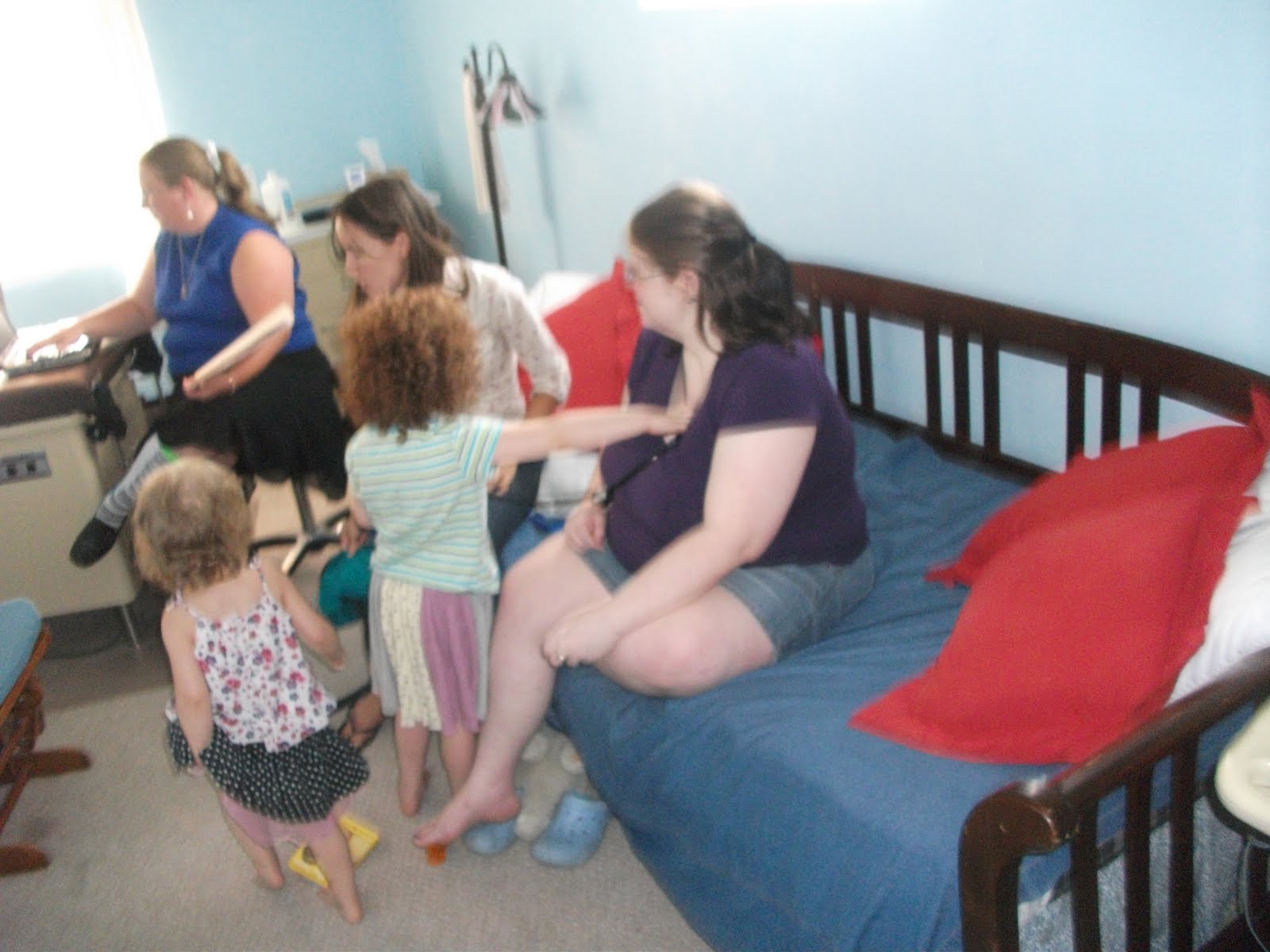
My kids were included in what was going on. At my last appointment, my oldest was taught how to pump the sphygnomanometer and today, she and her sister both got to pump it up most of the way before the assistant needed to take over and get the actual reading.
Then everyone took turns listening to my heart.
Seriously, a picture is worth a thousand words. When are you ever going to see the scenes above at an OB's office? And an appointment isn't the same either. Today was my glucose test and it was probably the longest I ever waited--about ten minutes--while I paced around, letting my grape juice burn off (as being stationary is bad for the test!) and poked around the rooms (which is when I saw the O2 tank for the first time, actually) curiously. I've had the pleasure of watching the birth center be turned into the lovely building that it is now, since it was so new when I first started coming.
While my daughter shot darts at the door under the encouragement of my midwife and her sister laughed, stealing them and running back to Daddy, we talked about diet (protein, protein, protein!), concerns, where I'd want to transfer if I had preterm issues (my concern I brought up today), how to effectively communicate in labor and dealing with trauma from previous births.
At our last appointment, we talked about music and their available equipment for listening to it and the variety that mamas brought in. She also talked about my birth stories (which she read here on the blog) and how we could most effectively get me the birth I wanted (and she met my doula).
It's such a huge difference--I feel like a person, not a patient. My kids feel welcome and I'm really looking forward to birthing there. I don't feel like I have to make a plan to protect myself from staff--I know the 'staff.' It's my midwife, her assistant and my doula. It won't be whoever's on call at the time with mostly nurses taking care of me with the luck of the draw.
So, for me, there's been a huge difference and definitely a greater happiness and satisfaction with my care in this pregnancy. Not just the difference of a midwife, but the right midwife. And that's something I wouldn't trade for anything right now.
Wednesday, July 20, 2011
Monday, June 20, 2011
Infertility depression

During this time, all sorts of thoughts can go through your head. Feelings of inadequacy aren't uncommon and neither is depression. It starts with the trying to conceive (TTC) cycle. First, there's excitement, as we finally decide to try. We know it might not happen right away, so we first just stop any birth control measures that might have been in use and just enjoy sex au natural.
After that doesn't work, we start timing. Some people buy ovulation predictor kits (OPKs) and some watch for signs of fertility (cervical fluid, maybe mild cramping--mittelschmerz). Others start charting their temperatures and many do all at once.
We hear the stats--two healthy, fully fertile people have about a 25% of conception in any given month. Okay, so, a few months have passed, this month should be it! We're doing everything right--we know when we're ovulating, we're going at it like bunnies on a schedule (some every day, some every other day in an attempt to give the sperm a chance to build up) and we're still not getting pregnant.
Doubts, that many of us already carried, perhaps in silence, for a long time, start to surface--"Can I even get pregnant at all?" Many women, especially those who successfully use birth control for a long time, actually worry that they may not be able to have children, though they have no real reason to feel that way. Sometimes it's a real, conscious concern or fear, sometimes it's subconscious, only waking up when the reality of actually trying to conceive arrives.
Often, what follows is depression. For me, I felt disconnected from the living world. I couldn't do the most basic of life tasks--reproduce. It made me feel broken, like I was really dead inside and something was seriously wrong with me. I watched other women with their bellies ballooning, bemoaning their human fertility and it hurt. It hurt a lot.
Every time someone talked about being 'afraid' of being pregnant, I wanted to scream at them to just give me the baby. I wanted the baby, don't be afraid, don't worry, just hand it over! Of course, instead, I tried to be supportive, while inside, I hated them a little in my pain.

Others go on to schedule workups to find out what's not working--many hope that it's their husbands and not them. Some try more natural approaches with herbs or supplements. And others make the decision to stop trying to conceive entirely and move onto looking into adoption.
From there, some go on for fertility treatments and more still move onto adoption options. And across the board of the women in treatments, using natural help and just keeping on the old fashioned way, women start getting pregnant: Finally!
Now, many recover and their spirits fly at this point. They've succeeded! However, many others continue to suffer from depression into the pregnancy. For me, I was unable to believe that I was really pregnant. I tried to find causes of positive pregnancy tests outside of pregnancy. The only one that seemed to fit my symptoms was a tumor. So, while I carefully nurtured my body in case I was wrong, I inwardly braced myself to face the big C.
This manifests in other ways for other women. However, it can lead to a distinct inability to bond in many women, for many months. You might not be able to believe you're pregnant, even when you're going through all the motions of nourishing a pregnancy. The depression that came from all those months of unsuccessfully TTC can utterly spoil what was supposed to be a joyous time in your life. Something you were waiting months or years for. Something very special.
This depression can persist throughout pregnancy and a little beyond, especially if you have a highly medicalized birth. If you experienced pregnancy or birth loss in the past, it can increase the problems quite a bit. Of course, the depression and bonding difficulties don't dampen any of the feelings of loss if the pregnancy ends unexpectedly.It could even make them worse.
Most women start bonding and recovering from the depression during milestones in pregnancy. The quickening is a big one--feeling the baby move, really move around in there, can push through that infertility depression fog. Sometimes, the first time mom hears the heartbeat makes it all real and connects her to the little life growing inside. Other mothers find comfort in a routine ultrasound showing them their active little bumper is really and truly a baby. Others still find random triggers, some not even related to pregnancy, that lead to pushing through the fog. Finally, the big show--birth--may be what it takes to really chase away those issues.
This post was really written to let other moms know: you're not alone. This is a problem that affects many, many women. It's not a sign that anything is wrong with you--it's a kind of traumatic response, even a defensive mechanism. It will eventually pass. However, my friend Dionna at Code Name: Mama has some great suggestions if you're currently pregnant and going through this, that might be helfpul.
Subscribe to:
Posts (Atom)